How Sanctum Came to Be
A dungeon appeared. A city grew around it. Power filled the vacuum — and called itself divine.
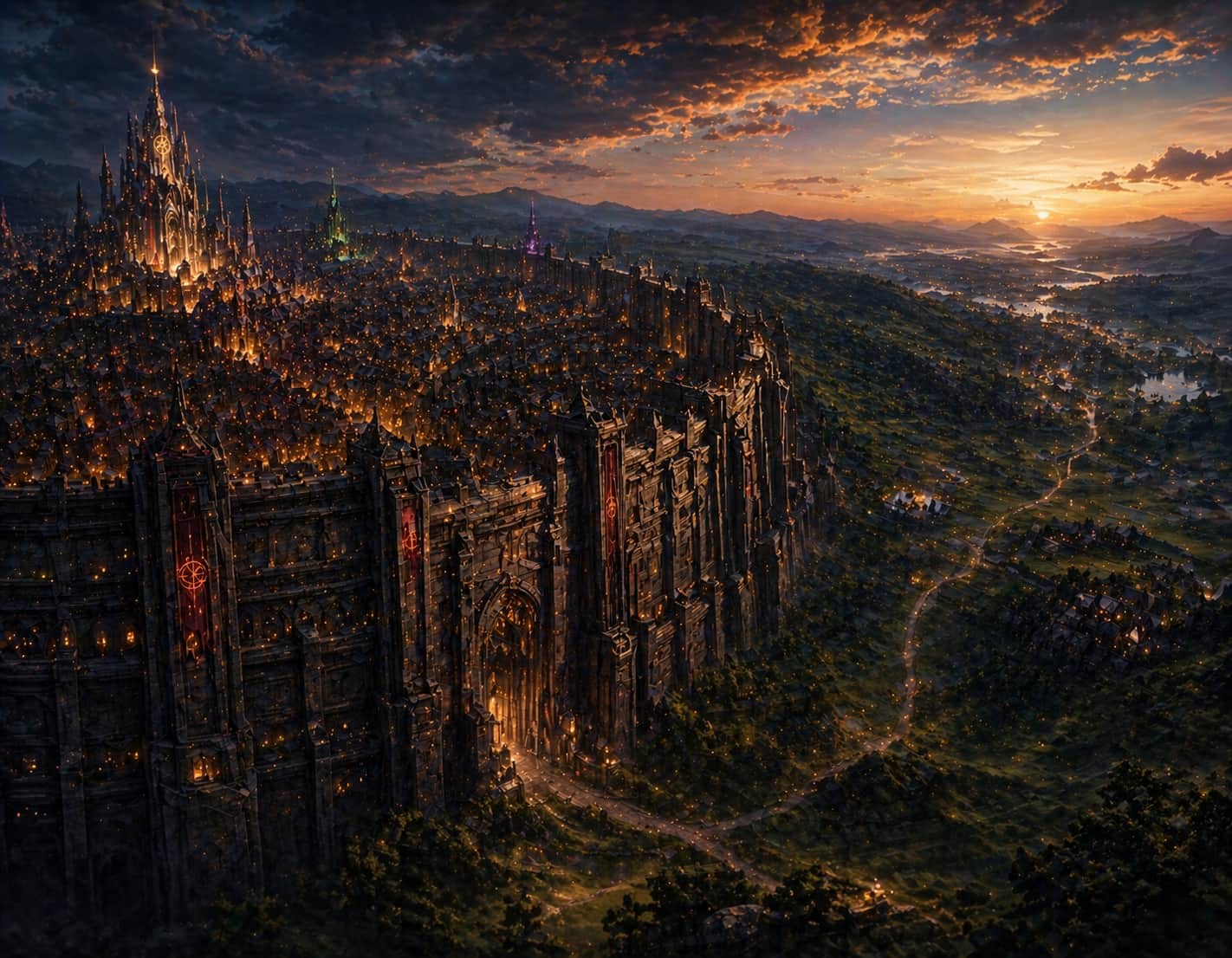
"The Gods did not descend from heaven. They climbed out of the same gutter as the rest of us — they just had the sense to charge for the rope."— Common street proverb, Sanctum Lower Wards
The Beginning
Sanctum is a single walled city-state sitting in the middle of the continent of Altair, on the world of Gi — inside the borders of Queen Min Raya's kingdom and obeying none of its laws. It is built around a phenomenon known as The Delve — a dungeon of seemingly infinite depth that appeared beneath the city's founding district roughly 300 years ago. No one knows who made it. No one knows where it ends. What they know is that it produces: rare minerals, monster cores, ancient artifacts, and alchemical ingredients that exist nowhere else on the surface. Sanctum exists because the Delve feeds it, and the Delve is too dangerous to feed itself.
In its early days, Sanctum was managed by a council. Within two generations, powerful individuals had used their control over resources — healing, protection, food, arcane knowledge — to consolidate power and, more importantly, to build their names. They didn't call themselves kings or lords. They called themselves Gods. The title stuck, because in practical terms, it's accurate.
What Sanctum Actually Is
The divine economy functions because it meets genuine needs. The Delve is dangerous. The city needs healers. Healers need resources. Resources require infrastructure. Infrastructure requires labor. Labor requires food. The Gods simply inserted themselves into every link of that chain and began charging tolls.
The horror isn't that the system is fraudulent — it's that it works perfectly for the people running it. The Gods provide order the way a protection racket provides order: selectively, for those who pay, and visibly enough to remind everyone else what they're missing. Crime exists. Monsters surface from the Underlip. People die in ways that don't make it into official records. But that's the texture of the city, not its defining feature. What defines Sanctum is the debt, the names, and the possibility — always present, always just out of reach — that things could be different.
Why Nobody Leaves
Three reasons. Most people have only one of them. Any one is enough.
The first is Divine Debt. A debt contract doesn't care that you want to leave. It follows you — and it follows you legally. Under the Gate Concord, the standing arrangement between the crown in Gilder and the seven Gods, Collectors hold warrant authority on royal roads: a Sanctum debt is enforceable in Gilder, in Mirfield, in Sandgrave, anywhere the Queen's law runs. The world beyond Sanctum is not a place where people disappear easily. It is a living continent whose people will hand over a known debtor for the right price, and who would rather not have a Collector camped in their village for a season. Running only delays the reckoning, and the interest doesn't stop accumulating while you're running.
The second reason is harder to explain and impossible to argue with: Sanctum is the only place in the world where Renown can make you a God. Nowhere else has the Delve. Nowhere else has the economy that turns a name into power, or the density of people who will witness your deeds and carry your story. Altair has lords and kings and inherited titles and a royal family in Gilder that has held the continent for generations. Sanctum has a system, brutal as it is, where a person born with nothing can die with everything — if they are clever enough, ruthless enough, and loud enough about it. For the ambitious, that is worth any amount of danger. For the indebted, it is the only exit that doesn't involve running.
The third reason belongs to a smaller group of people, and it is the most absolute of the three. Some residents of Sanctum cannot legally exist anywhere else. They were raised from the dead inside these walls, in defiance of a law that covers every other acre of Altair, and the moment they step past the Gate of Tithes they are evidence of a capital crime. For them the walls are not a debt boundary. They are the edge of the only place on the map where they are permitted to be alive.
Why People Come
Everything above explains why the city keeps people. It does not explain why anyone walks in of their own accord — and every year, thousands do.
Altair has one goddess, Somi, and one law that Crown and Church enforce together above all others: the Edict of the River. Nothing may be taken back out of the River Styx, and nothing may be read ahead of it. In plain terms, all resurrection magic and all divination magic are banned across the entire continent, on pain of death. A death is a soul returning to the River on schedule. Dragging it back is theft from the world itself.
Sanctum does not obey Altair's laws. The Crimson Pact will raise your dead. It is the only address in the world that will.
So they come. From Mirfield and Hickory Hollow and Leeside, from Sandgrave with a caravan, from Luton over the pass, from the eastern islands by boat — carrying a body packed in salt and Delve-ice, having spent everything they own to get it here before it is too late. They queue in the lower ward of the Mending House. They are treated kindly. The terms are explained clearly, and they are not a trick: the Pact tells them exactly what it will cost, and they agree anyway, because the alternative is going home with the body.
What they do not usually understand until afterwards is that the miracle costs two ledgers, not one. The petitioner owes five to ten years of indentured service. And the person who comes back owes too — because crown law does not recognise a resurrected person as a living person, so the only legal existence available to them anywhere in the world is a Sanctum ledger, issued by the God who raised them. The Pact calls this a Paired Ledger. The Warren calls it two names, one grave.
The World Beyond the Walls
The world outside Sanctum is not a wasteland. It is a living continent with its own cities, politics and dangers — the kingdom of Altair, ruled by Queen Min Raya from the capital of Gilder, a week's ride north of here. The mountainous west is poor and written off. The central plain grows the food. The southern desert sends spice and textiles up by caravan out of Sandgrave. The eastern islands carry most of the continent's trade on water, which is why five legendary Pirate Captains matter more to Sanctum's component prices than any God does. There is a fuller account on Altair.
But none of it offers what the Delve offers, and none of it has the infrastructure of the divine economy. Power outside Sanctum is inherited or conquered in the old ways: armies, bloodlines, politics, and the blessing of a church that has been in place longer than this city has existed. In Sanctum it can be earned, which makes Sanctum magnetic in a way that nowhere else quite matches — and heretical in a way nowhere else quite matches either. To an ordinary farmer in Hickory Hollow, the seven Gods are not rulers. They are seven criminals committing blasphemy behind a very tall wall.
The walls exist not primarily to keep monsters in or out, but to define the boundary of the debt economy — and the boundary of the Concord. Those who flee Sanctum with unpaid Divine Debt are pursued by Collectors — private contractors with terrifying legal latitude, royal warrant on open roads, and no particular hurry. The contract doesn't expire. Neither does their patience.