Altair — The World Outside
One goddess. One queen. One law about the dead. Sanctum breaks all three and nobody has stopped it yet.
Sanctum is not the world. It is a single walled city-state sitting in the middle of the continent of Altair, on the world of Gi — and everything about the way Sanctum works is a reaction to the continent around it. The Gods are heresy here. Renown is worthless here. And the one thing Sanctum sells that no one else in the world will sell is the reason strangers keep arriving at the Gate of Tithes with a body wrapped in salt.
This page is the world your character came from, unless they were born in the Warren. Most weren't.
"Everything that lives came out of the River. Everything that dies goes back to it. Only one city in the world sells you a way to reach in and take something out."— Somist catechism, taught to children in Gilder
Somi, and Why Sanctum's Gods Are Called False
Altair has one goddess: Somi, the Goddess of Dreams, who made the world after defeating the primordials that wanted it unmade. Her only commandment is that you pursue your dream — not your daily wants, but the large shape of the life you mean to have. Chasing that is how you worship her. Her priests are called Somists, and the church works hand in glove with the crown.
So when seven people in a walled city started calling themselves Gods, the rest of the continent did not hear ambition. It heard blasphemy. That is the origin of the phrase a city under false gods — it is not a Sanctum expression. It is what everyone else in Altair calls the place.
The uncomfortable part, which senior Somists will admit and junior ones will not, is that Sanctum may be the most devout city in Altair. Every soul in it is chasing a dream with both hands. Deep in the faith it is understood that Somi does not require the dream to be a kind one, and that a person can hold her blessing while doing something monstrous, so long as they are truly reaching for the life they mean to have. The Church does not preach this in the Warren. The Gods of Sanctum have never needed it preached.
The River Styx
Surrounding the world, high above it, runs the River Styx — a river of energy from which all life is born. Everything that lives comes out of it, born as a dream made real. Everything that dies returns to it and becomes part of the world again.
This means everyone in Altair is reincarnated, and everyone knows it. You carry no memories from a past life, but you may carry inclinations: why you were born bulky, or quick, or clever, or why your hands already knew what to do the first time you touched a chisel. Skills you nourish in this life may travel to the next one. It also means the energy of the dead is genuinely present in the world around you — a gust of wind, the sun's warmth on your face may be a bit of someone you once knew, reaching out.
Sanctum is the one place in Altair where almost nobody says this out loud. There is very little wind in the Warren and very little sun in the lower rings, and a city that sells resurrection has an obvious interest in people not thinking too hard about where the soul went in the meantime.
The Edict of the River
Crown and Church agree on one law above all others, and it has two clauses. Nothing may be taken back out of the River. Nothing may be read ahead of it. In plain terms: all resurrection magic and all divination magic are banned across Altair, on pain of death.
The reasoning is doctrinal, not practical. What happens is what Somi intends. A death is a soul returning to the River on schedule. Dragging it back out is theft from the world itself. And peeking at the future warps how things were meant to play out — a prophecy, once spoken, changes the thing it described.
Queen Min Raya and the royal family enforce this from the capital, Gilder, and they enforce it without much ceremony. Speaking a prophecy in public is sufficient grounds to be cut down where you stand. Clerics of respectable standing have been executed for a single act of mercy over a fresh corpse.
The Gate Concord
Sanctum is inside Altair's borders and does not obey Altair's laws, which is a situation that ought to have caused a war three times over. It hasn't, because of a standing arrangement between the crown and the seven Gods that both sides prefer not to discuss in detail.
The terms, as far as anyone outside the Spire District can reconstruct them:
No royal garrison, no royal courts, no Somist authority inside the walls. Contract law — the Scales of Morreth — is the only law that runs in Sanctum.
Collectors hold legal authority beyond the walls. A Sanctum debt is enforceable in Gilder, in Mirfield, in Sandgrave. This is why running doesn't work.
First refusal on monster cores, vein ore and pre-Sanctum artifacts, at a price fixed three hundred years ago. Altair's army is equipped out of a hole in the ground it does not have to police.
Everything the Edict forbids happens in a city the crown can honestly say it does not govern. Nobles who need a miracle the Church would hang them for go to Sanctum quietly, and the Church holds no jurisdiction there to notice.
There is a fifth clause, and it is the one that shapes every God's ambition: no God of Sanctum may claim title, land or Sphere beyond the walls. Their power stops at the Gate of Tithes. A God can own the lives of a hundred thousand people and still not legally own a single field in Hickory Hollow. Some of them have made peace with that. At least one has not.
The Regions
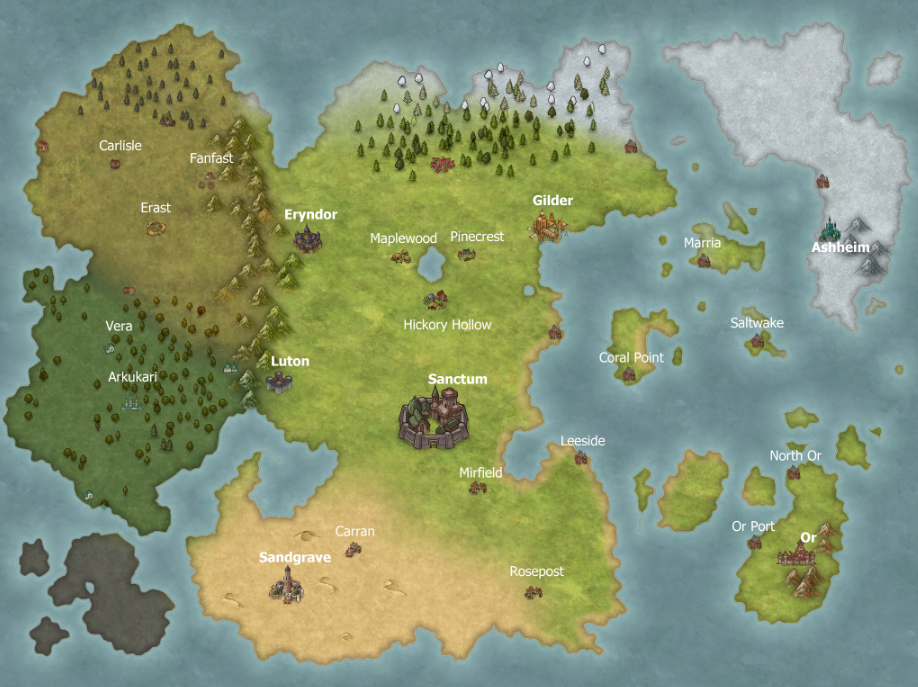
The West — Carlisle, Fanfast, Erast, Vera, Arkukari, Luton
The land of old usurpers and betrayers, and treated accordingly ever since: poor, rough, written off as the country of heretics and thieves. The mountain range cuts it off from the kingdom's supply lines, so it survives on its own logging, farming, mining, fishing and a genuinely superb alchemical trade nobody in Gilder will credit. Luton holds the pass, which makes it the gateway for western ore heading east — and the easiest place in Altair to hire someone who has never heard of your ledger.
Central Altair — Gilder, Eryndor, Sanctum, and the farm country
The royal family, the capital, and most of the continent's large cities. Every resource in Altair eventually passes through here. People of all classes live in it. Gilder is the seat of Queen Min Raya and the Church both. Eryndor sits north-west against the mountains, and is currently the most talked-about city on the continent. The farm towns — Maplewood, Pinecrest, Hickory Hollow, Mirfield, Leeside — feed the region, and feed Sanctum, whether they like it or not.
The South — Sandgrave, Carran, Rosepost
Desert and scrub below the central plain. Thin population, enormous margins: luxuries, spice and perfume out of the deep desert, weaving and textiles along the southern coast. Sandgrave caravans are the only reliable way to move any of it, and caravan work is one of the few trades in Altair that will hire a person without asking which city they walked out of.
The East — Marria, Saltwake, Coral Point, Or Port, Or
Mostly islands. Villages and cities connected by water, and a very large share of Altair's resource gathering and trade happens on boats. Which means piracy: five legendary Pirate Captains hold the eastern territory between them and are a permanent threat to the kingdom's supply. Sailors and slaves lead short, dangerous lives out here. Every price the Pale Archive quotes on imported spell components is really a quote on whether the captains felt like working that month.
Ashheim — the frozen north-east
A cold, half-empty island whose one export matters more than its population suggests: spell components found nowhere else above ground. The Pale Archive's only serious rival supply — and the only reason the Archive has ever had to negotiate for anything. Ashheim shipments come south through pirate water, which is a problem the Archive has been trying to solve, expensively, for a century.
Dragons, and the Eggs That Never Hatch
Some time ago, massive lizard-like monsters called dragons lived in Altair: mythical, powerful, cunning, wise, feared and revered in equal measure. There are stories of mortals whose eyes changed colour to match a dragon egg, forging an irreversible bond between dragon and man.
They died off long ago. No such bond has been known to exist in a very long time. Eggs still surface from time to time — and it is common knowledge that they will never hatch, which is why they are traded as rare gems and ornamental artifacts rather than as anything living.
A steady trickle of them comes up out of the Delve. The Pale Archive catalogues each one as inert gemstock, ornamental, Class 4, and sells them to Spire District collectors who like the story more than the stone. Every egg that has ever passed through Sanctum is on record somewhere in the Archive's vaults, with a name attached to it. If you are carrying one, someone has a ledger that says whose it was.
The Rift, and the Prophet at Eryndor
Recently a massive rift opened in the sky above the mountains near Eryndor. No one knows how, or why, or whether it is a threat.
Then a man climbed onto the gates of Eryndor and began to speak a prophecy he said he had received. The rift, he said, would lead to Altair's doom — by year's end the destruction of the continent would come — dragon's breath would —
He was cut down mid-sentence for breaking the ban on divination.
Rumour of the illegal prophecy spread across the kingdom faster than the crown could contain it, and caused real unrest, until the royal family issued a statement that they were handling the rift and that people should carry on as normal. Since then the prophet has been thoroughly discredited as a panic-monger rather than a true seer. The origin and purpose of the rift remain entirely unknown.
The Call at Eryndor
Despite the crown's reassurances, the prophet's last two words have not stopped circulating. Duke Regulus Orlaith and his son Felix have sent a call to action across the kingdom from their estate in Eryndor: should any person bond with a dragon egg, as was done in the old ways, they are asked to come.
The call was largely ignored, and widely laughed at. Nobody has bonded with a dragon egg in hundreds of years. The eggs are gemstock. Everyone knows this.
What Altair Thinks of You
Worth knowing before your character opens their mouth outside the walls. To an ordinary person in Gilder or Mirfield, someone from Sanctum is a debt-marked heretic who worships seven criminals and will be hunted down if they run. Her neighbours will not give a Sanctum refugee shelter — not out of cruelty, but because a Collector with a royal warrant is more trouble and more danger than any stranger is worth.
Independent merchants and travellers avoid the city for the same reason. Sanctum's trade moves almost entirely through bonded factors — licensed middlemen who take the risk, hold the paperwork, and never live inside the walls. Grain, stone, spice, textiles and components all arrive at the Gate of Tithes in someone else's name. Very little of it arrives in the hands of the person who grew it.
So: news reaches Sanctum, goods reach Sanctum, and pilgrims reach Sanctum. Neighbours do not.