Power in Sanctum
Where it comes from, what it costs, and the device on your wrist that tracks both.
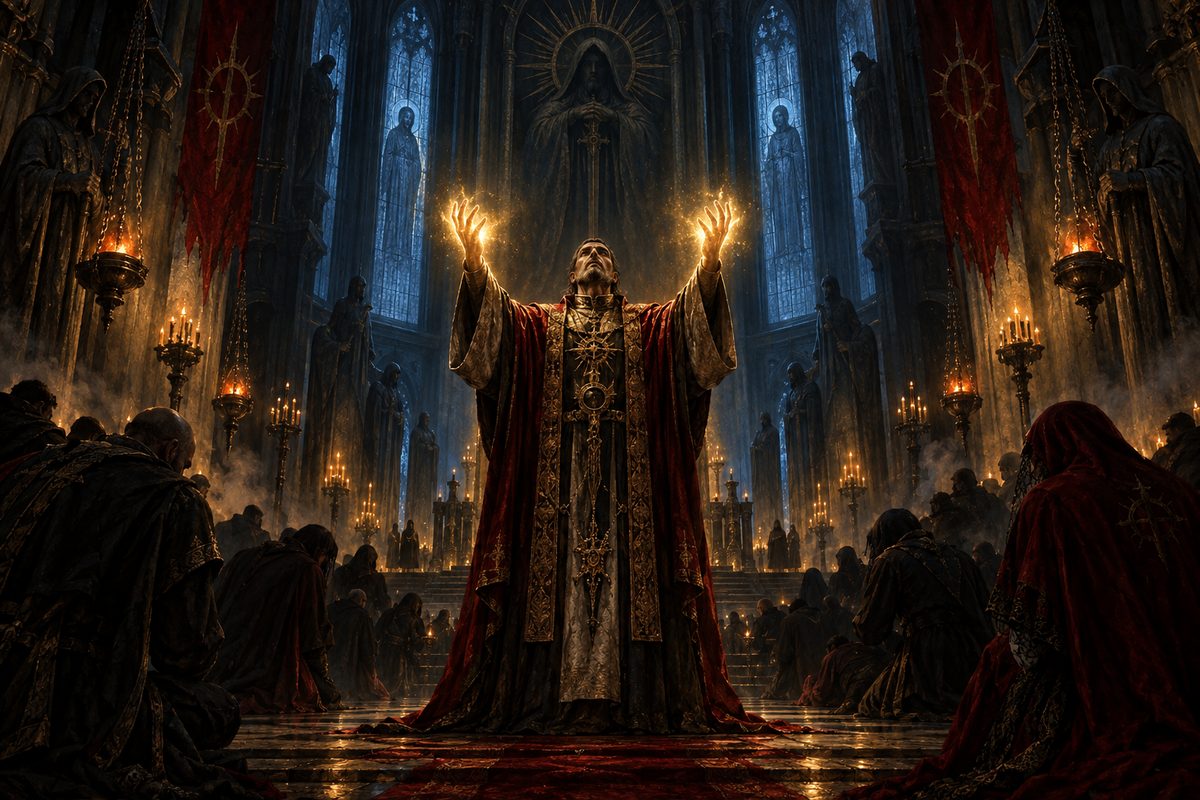
"Magic in Sanctum is not mysterious. It is licensed."— The Pale Archive, Standard Spellcraft Registration Document, Preamble
Magic
Magic in Sanctum exists on a spectrum from the deeply institutionalised to the genuinely unknown. At one end: the Gods, whose power is vast, licensed, and enforced by contract law. At the other: what comes out of the Delve's deeper floors, which behaves by rules nobody has fully documented. In between is every individual who has learned to use magic — through Archive training, through raw talent, through Delve exposure, or through methods that don't appear in any official record. All of them are, technically, operating within the Pale Archive's jurisdiction. What varies is whether the Archive knows about them.
The Four Kinds of Magic
Divine Magic is performed by sanctioned Clerics and Paladins within their God's Sphere — healing, warding, truth compulsion, contract binding, the full range of miracles a God can grant. It is the most powerful and most reliable magic in Sanctum, backed by three hundred years of institutional refinement and the genuine belief of its practitioners. Every use generates a Debt Contract. This is not a side effect. It is the point.
Licensed Arcane Magic is learned through the Pale Archive's training programs and performed under a registered license. Every spell a licensed wizard casts is logged. Licensing fees are charged annually and scaled to the power tier of the spellcaster. The Archive controls which spells are approved for civilian use and which are restricted or quietly removed from the curriculum without explanation. Licensed practitioners are the largest group of magic users in Sanctum and among the most carefully watched.
Self-Taught Magic is developed outside Archive oversight — through natural talent, prohibited texts, Delve exposure, or teaching passed between people the Archive doesn't know about. Technically illegal to practice unregistered, but the Archive's enforcement is imperfect, and the Warren's population of unlicensed practitioners has been growing for two decades. What it lacks in refinement it makes up for in the fact that nobody has a record of it.
Delve-Born Magic emerges from extended exposure to the Delve's deeper floors — absorbed rather than learned, operating by rules that don't fully align with any existing magical framework. Rare, inconsistent, and occasionally extraordinary. The Archive classifies all Delve-born practitioners as research subjects with an ongoing obligation to report their abilities. Most don't. Those who do are not always glad they did.
Crown Law vs. Contract Law
Everything above describes the law inside the walls, where the only authority over magic is the Pale Archive's licensing regime, enforced under Scales of Morreth contract law. One week's ride north, in the kingdom that surrounds this city on every side, magic is governed by something much older and much less negotiable.
Altair's Crown and Church enforce the Edict of the River, and it has two clauses. Nothing may be taken back out of the River Styx. Nothing may be read ahead of it. All resurrection magic and all divination magic are banned across the continent, on pain of death — not fine, not licence revocation, death. A prophecy spoken in public is sufficient grounds to be cut down where you stand, and has been within living memory.
Sanctum is not subject to that law, which produces the single sharpest fact about magic in this setting: the two spell schools the rest of the world executes people for are commercial product lines here.
| School | In Altair | In Sanctum |
|---|---|---|
| Resurrection | Capital crime. Soul-theft from the River. Church and Crown both prosecute. | Crimson Pact product. Openly priced. Generates two ledgers — see The Paired Ledger. |
| Divination | Capital crime. Reading ahead of the River warps what Somi intended. | Pale Archive product. Never logged, never receipted, sold to a very short list of clients. |
| Healing, warding, enchantment | Lawful. Somist clergy and licensed practitioners. | Lawful. Licensed, logged, and billed. |
| Everything unlicensed | A church matter, handled locally and inconsistently. | Theft from a God's revenue. Handled by Paladins. |
This asymmetry is worth holding onto as a player, because it cuts two ways. Inside the walls, a divination is an expensive favour. Outside them, casting one makes you a fugitive from the Queen's justice — and under the Gate Concord, Sanctum's Collectors have warrant authority on royal roads while royal courts have none inside the walls. Magic that is merely unlicensed here is lethal there, and magic that is lethal there is a line item here.
Magic Items & Delve Components
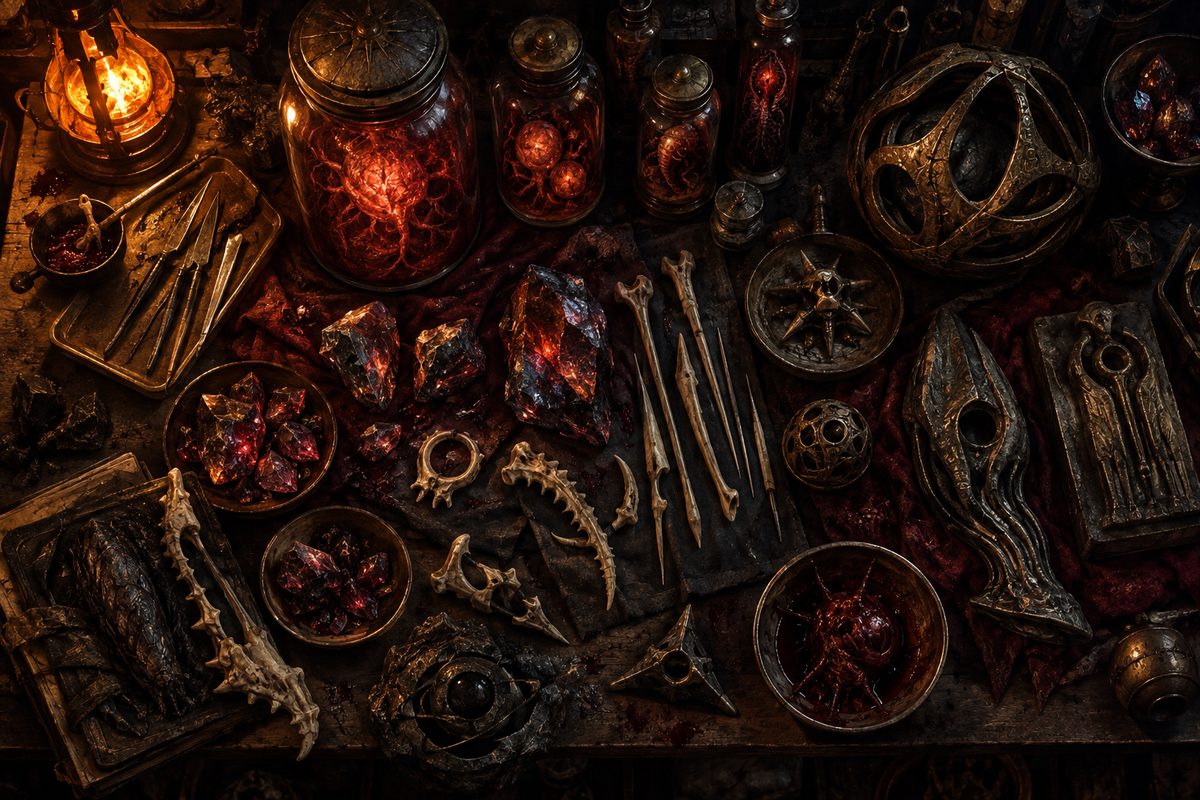
Every magical item of significance in Sanctum came out of the Delve, or was made using materials that did. The surface world produces craftwork. The Delve produces things that don't behave the way matter is supposed to behave — minerals that hold enchantments without degrading, cores that pulse with residual life force, artifacts from pre-Sanctum civilisations whose original purpose nobody has fully decoded.
Monster Cores are the basic currency of Sanctum's arcane economy. Every Delve creature contains a dense crystalline node — the concentrated residue of whatever animates them. Cores are extracted after a kill and sold to Brotherhood processing facilities, Archive research operations, or directly to licensed enchanters. Quality scales with depth: Shallows cores are commodity goods traded in bulk. A Floor 6 core is significant wealth. A Floor 9 core is the kind of thing people die over, which they regularly do.
Vein Ore is extracted from the Delve's mineral deposits and processed by Brotherhood smithpriests into workable material. Unlike surface ore, Delve minerals hold magical properties permanently once worked. The Brotherhood's monopoly on processing is the chokepoint the entire enchanted armaments trade runs through. What they certify reaches the Covenant Ring. What they don't certify reaches the black market, at prices that reflect the risk of not having certification.
Pre-Sanctum Artifacts are the most valuable and least understood category. Objects from the ancient civilisation whose ruins begin on Floor 4. Sealed relics — objects clearly designed to open or activate but that nobody has found the correct trigger for — fill a significant portion of the Pale Archive's vaults. The Archive classifies these as "Pending." Several have been pending for forty years. Objects from Floor 8 and below that don't fit any known framework at all are classified as unclassified, which is the Archive's way of saying it doesn't know what to do with them yet. The market for these among specific private buyers is extremely active. The Quiet Current maintains a list of those buyers.
Dragon Eggs come up out of the Delve in a slow trickle — perhaps two or three in a decade — and every one of them is a minor political event. Across Altair it is common knowledge that dragons died off long ago and that the eggs left behind will never hatch, which is why they are traded as rare gems and ornamental artifacts rather than as anything alive. The Pale Archive catalogues each recovery as inert gemstock, ornamental, Class 4, assigns it a provenance entry, and sells it on to a Spire District collector who wants the story more than the stone. The catalogue is the important part: every egg that has ever surfaced in this city is on record in an Archive vault with a name attached to it. See Altair — Dragons, and the Eggs That Never Hatch, and talk to your DM before assuming yours is legally yours.
The Ledger
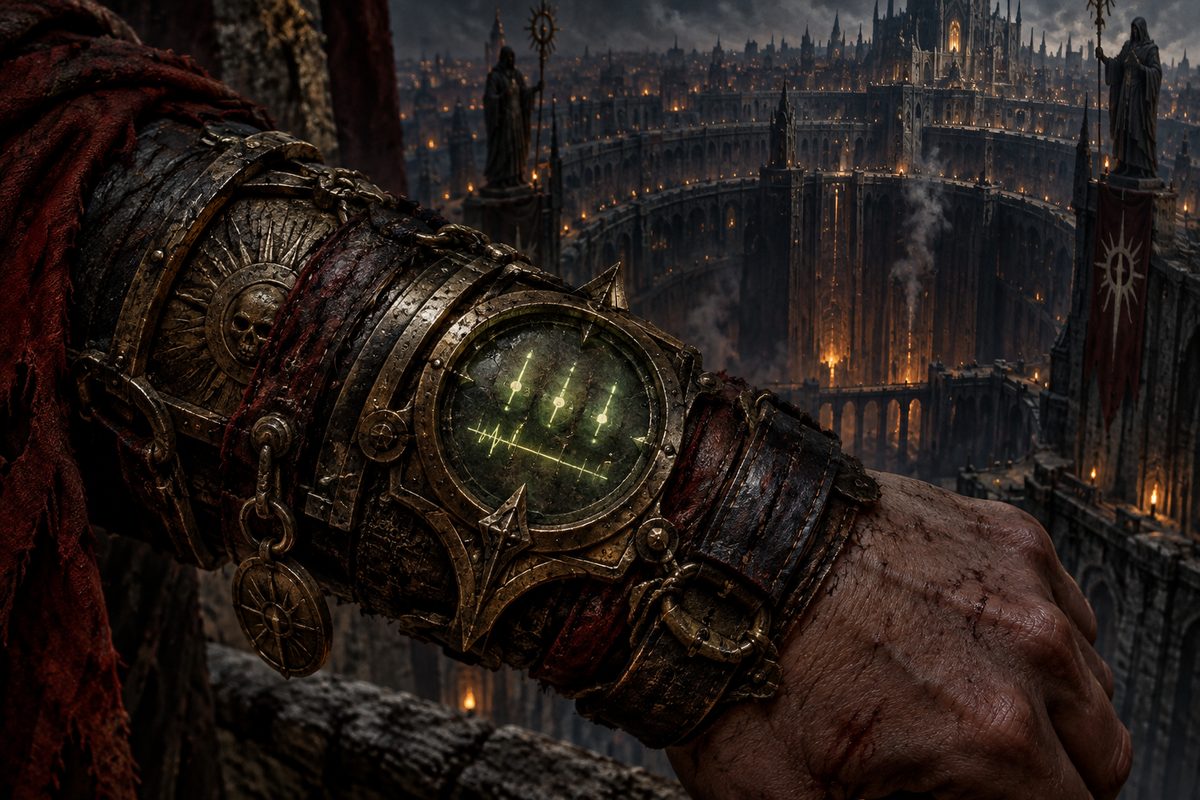
On your eighteenth birthday, a Scales of Morreth representative arrives. They attach a Ledger to your wrist. They explain what it does. They do not ask if you want one.
The Ledger is a magical device — part arcane instrument, part administrative tool, part surveillance system — issued to every registered Sanctum resident at the age of majority. It was designed by the Pale Archive and is administered by the Scales of Morreth. It has been in continuous use for over a hundred and fifty years. In that time, its core function has never changed: it tells the Scales of Morreth whether you are alive, where you are, and what you owe.
"The Ledger tells you what you owe. The Delve tells you what you're worth. Sanctum profits from the difference."— Overheard, The Depth Finder, The Throat
What the Ledger Does
Debt tracking. Your outstanding balance — principal, interest, and accrued penalties — updates in real time the moment any change registers with the Scales. You always know exactly what you owe. The number does not go away when you sleep. It is the first thing you see in the morning and the last thing you see at night. The Scales consider this a feature. They are correct that it is a feature. They mean something different by the word than most residents do.
Vital signs. The Ledger monitors your heartbeat, core temperature, and basic health status continuously. This data is available to the Scales of Morreth at all times. It is used primarily to determine whether a debtor is still alive and therefore whether their debt contract is still active. If your Ledger flatlines, succession protocols on your debt activate within the hour. Your heirs are notified before your neighbours are.
Jobs and notifications. Faction job postings, debt notices, and official requests from your marker arrive directly to your Ledger. You can accept or decline work through it. Formal contract offers appear here first. Debt enforcement notices appear here first. The notification tone that indicates a Covenant Warden has been assigned to your account is a specific sound that every Sanctum resident recognises by the time they are twenty-five.
Location. The Ledger logs your position passively. Your debt marker knows where you were last night. A Collector who loses track of you can query your Ledger's last known position through a Scales relay post. Entering the Delve is logged. The Throat's staging areas use Ledger pings to track active teams — this is the safety feature and the surveillance feature, using the same data for both purposes simultaneously.
General utility. Beyond debt and surveillance, the Ledger functions as a compass, timer, personal log, and messaging system. Many residents use it the way others use a notebook. Everything stored on it is technically accessible to the Scales of Morreth. Most people know this and use it anyway, because convenience tends to win against abstract privacy concerns.
Delve Mode. Below the Throat, the Ledger switches to a reduced-function state that prioritises vital sign transmission and basic navigation. Below Floor 8, it loses relay contact entirely. The Scales know you went in. They will not know what happened until you come back out — if you come back out.
The Questions Players Ask About the Ledger
Can it be removed? Technically yes. Removing a Ledger without Scales authorisation voids your debt contracts, triggers automatic default proceedings, flags you as a deserter in the Collector network, and alerts your marker within minutes. People have done it. They have generally not remained in Sanctum afterward.
Can it be tampered with? The Pale Archive built the Ledger's magical infrastructure. Any tampering is both an Archive contract violation and a Scales violation simultaneously. There are people in the Warren who claim to know how to alter Ledger readings. Whether they actually can is a matter of ongoing debate among people with strong reasons to find out.
What happens when it breaks? A broken Ledger triggers an automatic wellness check from the Scales within six hours, because a flatlined Ledger and a broken Ledger look identical in the registry. You have six hours to present yourself to a Scales relay post with a functioning replacement. The replacement fee is added to your outstanding debt.
What about people without one? Underlip natives who were never Scales-registered, people who arrived through unofficial routes, and those the Quiet Current has deliberately erased from the registry carry no Ledger. They are invisible to the system in ways that are either freedom or precarity, depending on what they need from the system — and in Sanctum, you sometimes need it, even when it works against you.