Miracles & Those Who Deliver Them
The Clerics perform miracles. The Paladins make sure you pay for them. These are not the same job.
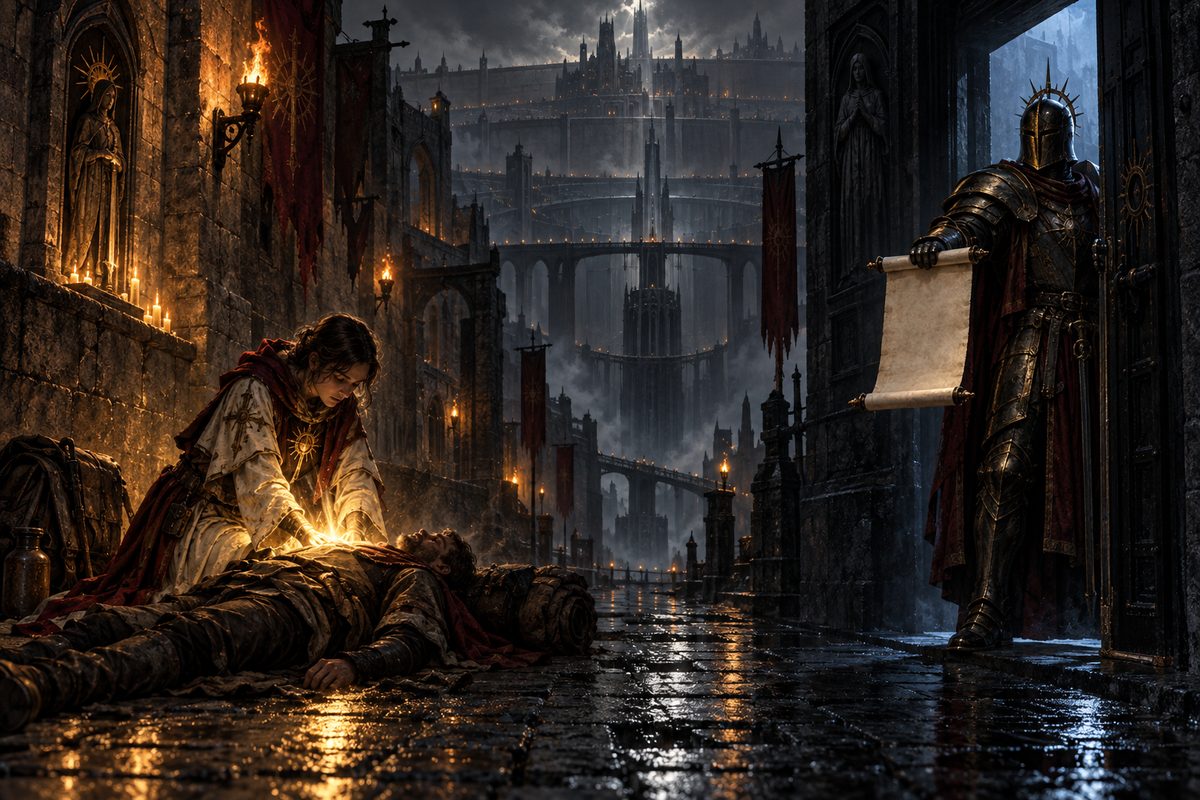
"A Cleric saves your life. A Paladin shows up three weeks later to remind you what that cost."— Common saying, Sanctum Warren
What Divine Favor Is
Divine Favor is the official term for what a God extends when they authorize a miracle. It is not grace — it is a line of credit. When a God grants Divine Favor, they authorize one of their Clerics to perform a service for which the recipient will be indebted. The miracle happens. The Debt Contract is generated. The favor is, technically, complete.
Clerics — The Miracle Workers
Clerics are the skilled workers of the divine economy — trained, licensed, and employed by a God to perform miracles within that God's Sphere. A Crimson Pact Cleric heals. A Pale Archive Cleric researches and enchants. An Abundance Cleric blesses food supplies. A Quiet Current Cleric — if such a thing can be said to exist — does things that don't get discussed in polite company.
Clerics draw their power from genuine alignment with their God's Sphere, not blind devotion to the person holding it. A Cleric who loses faith in their God but still believes in the domain they serve remains functional. The Gods manage this carefully. A Cleric whose values diverge too far from the God's interests eventually faces Defavoring — their miracle authorization is revoked, leaving them operating on raw talent, unlicensed and hunted by their former employer.
Paladins — The Covenant Wardens
Paladins are not healers, not counselors, not spiritual guides. They are the consequence. Every God maintains a corps of Covenant Wardens whose function is to ensure Divine Debt is honored — tracking defaulters, serving legal notices, performing lawful seizures, and when required, bringing force to bear on those who resist.
Paladins draw their power from the Debt Contract itself — specifically from the binding authority of the covenant between God and debtor. This makes them magically stronger the more legitimate their grounds for enforcement are. A Paladin acting within the exact letter of a valid contract is noticeably more dangerous than one operating on shaky legal footing. The best Covenant Wardens are obsessively lawful — not from morality, but because their power depends on it.
Miracles in the Delve
The Delve is where most Divine Favor is consumed and most Debt generated. The standard arrangement: a God sponsors a delver team with an embedded Cleric. The Cleric provides miracles as needed during the run. Every miracle is logged. The team surfaces, splits the haul, pays the God's percentage, and individual miracle debts are settled against that payment. If the haul is poor, the debts carry forward — with interest.
Independent teams who refuse sponsorship pay significantly more for freelance Cleric services. Most independent delvers either have healing abilities of their own, carry expensive black-market consumables, or die below Floor 3.
Miracles by Sphere
| Sphere | Common Miracles | Who Performs Them |
|---|---|---|
| Crimson Pact | Field healing, plague cures, childbirth assistance, resurrection | Blessers; senior Blessers for resurrection only |
| Pale Archive | Artifact identification, enchantment, translation, memory extraction, divination | Archivists; Loremasters for deep enchantment. Divination is never performed on the record. |
| The Abundance | Food preservation, crop blessing, poison detection, famine relief | Provisioners; rarely field-deployed |
| Iron Congregation | Battle blessings, warding, enhanced armour, fallen warrior rites | Wardens; nearly indistinguishable from their Paladins |
| Ashen Brotherhood | Structural reinforcement, forge blessings, material purification | Smithpriests; highly technical, workshop-bound |
| Scales of Morreth | Contract binding, truth compulsion, legal authentication | Arbiters; administrative miracles, legally inviolable |
| Quiet Current | Illusion, memory alteration, identity fabrication, silence wards | Unknown — if you saw one perform, you weren't meant to |
The Vigil
The lower ward of the Mending House exists for one purpose, and it is the closest thing Sanctum has to a pilgrimage site. Outsiders call it nothing; the Pact calls it the Vigil. It is a long stone hall with benches, where people from all over Altair sit with their dead and wait their turn.
Most of them have travelled for days — from the farm towns, up from Sandgrave by caravan, in by boat from the eastern islands — with a body packed in salt and Delve-ice. They are not treated cruelly. There is water, and there are attendants, and a senior Blesser explains the terms in full and in plain language, because the Pact has learned that honesty here produces better contracts than pressure does.
Every resurrection performed in the Vigil generates two Debt Contracts — one for the petitioner and one for the person raised, who has no legal existence anywhere in Altair except the ledger the Pact issues them. The full terms are on Divine Debt — The Paired Ledger.
Only senior Blessers may perform the rite, and only Sera Valdren may authorise it. The Undying Matron reviews every petition personally. She is said to consider it the most important work the Pact does, and she is not being cynical when she says so. That is exactly what makes her dangerous.
The House of Small Dreams
There is one building inside Sanctum's walls where a miracle costs nothing, and it is not run by a God.
The House of Small Dreams is a Somist mission in the Warren — a handful of priests of Somi, funded out of Gilder, protected by a clause in the Gate Concord that the Gods have never managed to have struck. They heal for free. No contract, no ledger, no tithe. They will treat a defaulted debtor the Cathedral healers have blacklisted, and they will do it in the open, which the Crimson Pact regards as a direct commercial attack and cannot legally answer.
They are not a sanctuary, though. Somist doctrine is what it is: death is a soul returning to the River on schedule, and the Edict of the River is the Church's own law. So the House will set your broken leg for nothing and then tell you, to your face, that wanting your wife back is a sin against the goddess and against the world. The single most desired miracle in Sanctum is the one miracle they will never perform.
Gray Blessings
Unsanctioned miracles — performed without an authorized Debt Contract — are called Gray Blessings. They are illegal under Scales of Morreth contract law, practically common in the Warren, and the primary economic engine of the Quiet Current's shadow network. Gray Blessings are paid in coin, silence, or future favours — never in registered Debt. You can't be tracked through the official ledgers, but you also have no legal protection if something goes wrong.
Gray resurrection exists, and it is the most expensive transaction in the city. A Defavored Crimson Pact Blesser who still remembers the rite can raise your dead without a Paired Ledger — no contract, no second debtor, no God owning the rest of two lives. What you get instead is a person who is legally dead in Altair and does not even have a Sanctum ledger to stand on: no papers, no ward registration, no protection from anyone. Some people consider that a bargain. The Crimson Pact hunts the Blessers who offer it more aggressively than it hunts any other defector, for reasons that have nothing to do with doctrine.