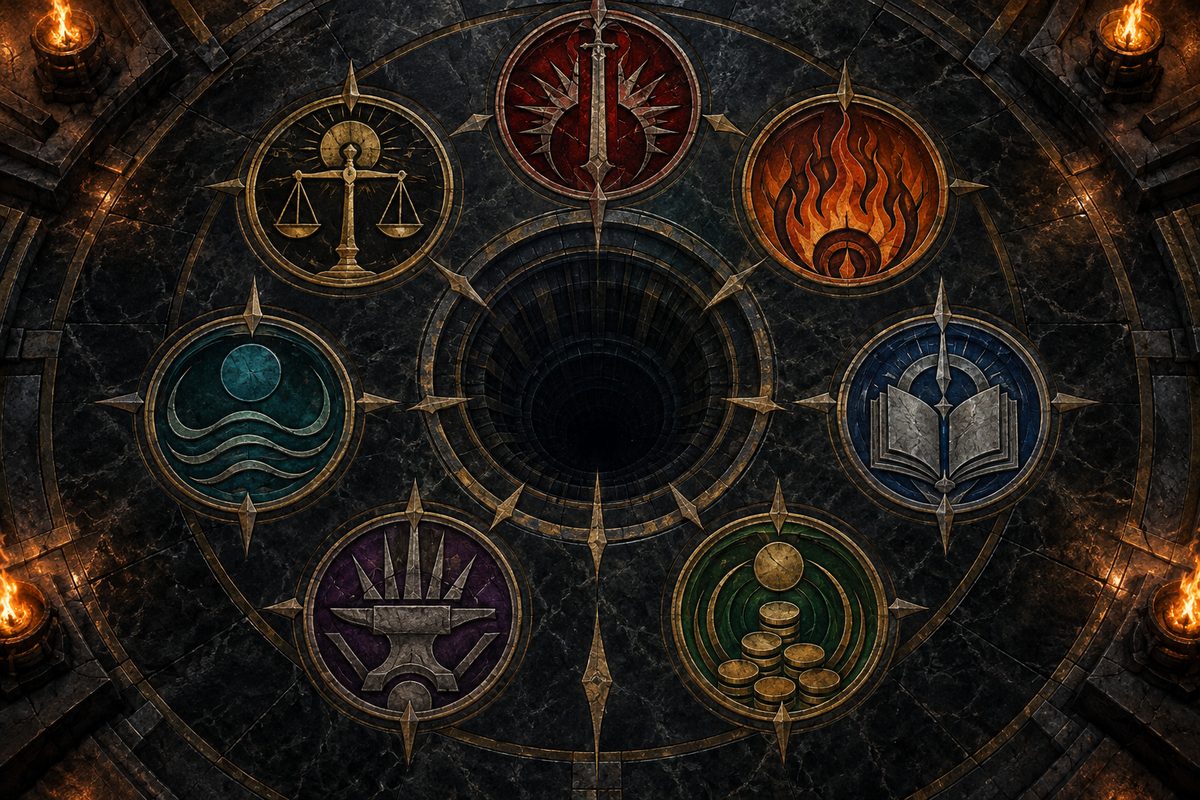
Seven Gods. Seven Spheres. Seven Chains.
Each controls something essential. None of them got there by being kind. Tap a faction to read their full profile.
The God
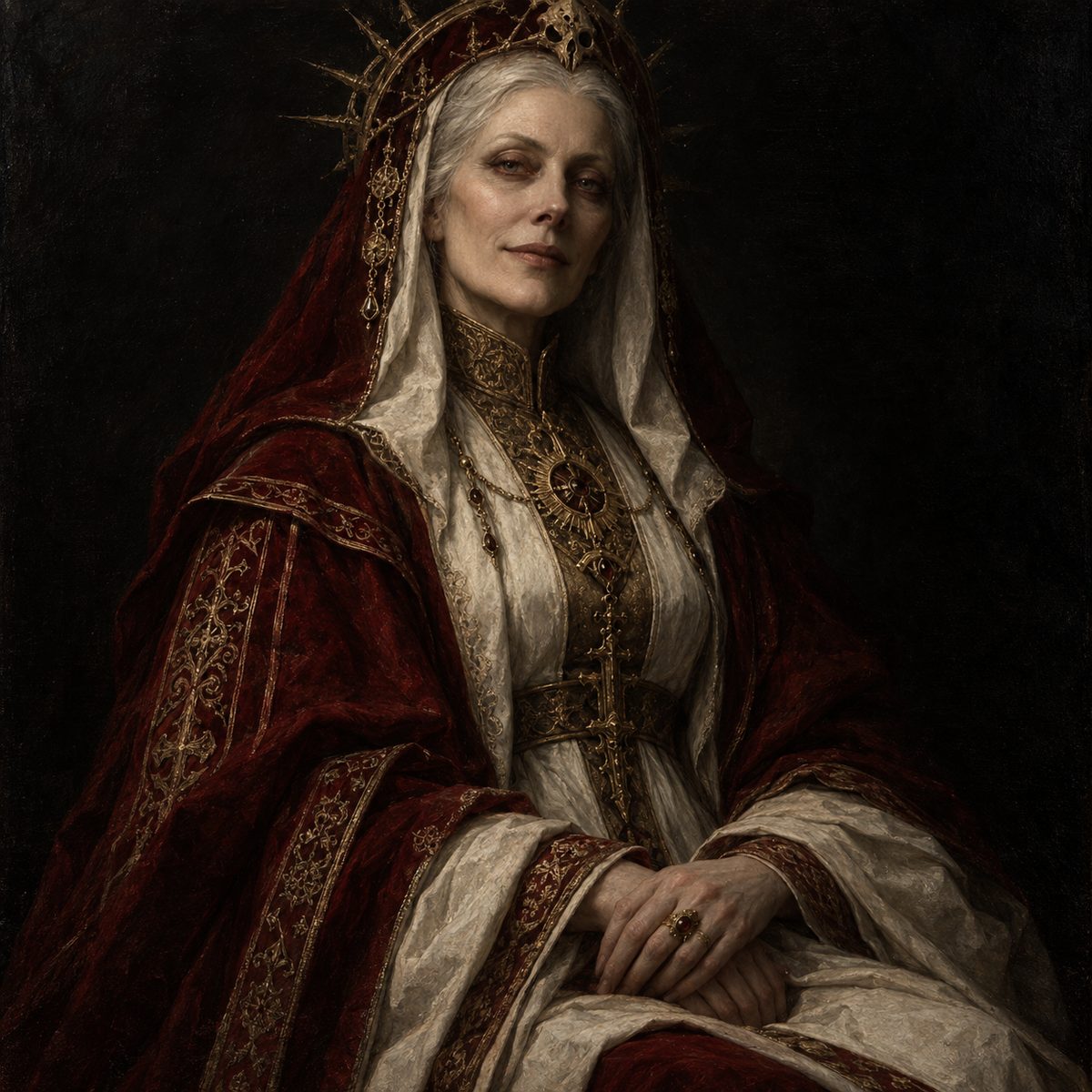
Sera Valdren — "The Undying Matron"
An ancient woman who has not visibly aged in over forty years. Whether this is her own miracle, a contract with someone more powerful, or simply the effect of being too stubborn to die, no one has asked her directly and survived the conversation comfortably. She is warm, soft-spoken, and utterly pitiless about debt enforcement. She genuinely believes she is doing good — that people owe her their lives because she gave them their lives. That sincerity is what makes her dangerous.
How They Operate
Crimson Pact Clerics — called Blessers — are deployed to disasters, battles, and plague zones to maximise debt generation. Every person they save is a new contract. They also maintain the city's only orphanage, which serves as a labour pipeline for children born into inherited debt. The Crimson Pact holds more generational debt contracts than any other faction.
What They Want From You
Your life, on their terms, for as long as they need it. They extend a great deal of credit. They collect every coin of it eventually.
The God
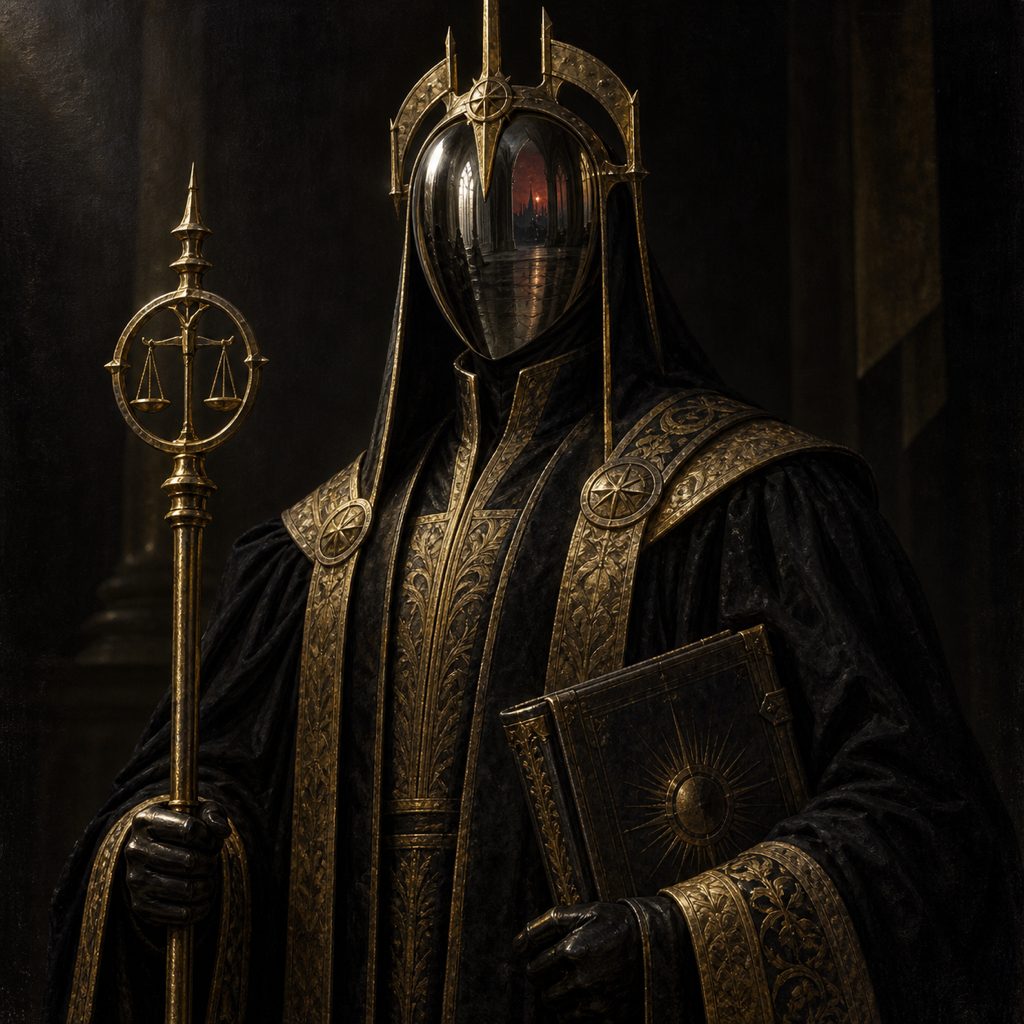
Vael Morreth — "The Arbiter"
Vael appears in public only behind a mirrored mask, speaks in a measured voice stripped of warmth or anger, and has never been provably caught favouring one faction over another. Whether the Arbiter is truly neutral or simply too intelligent to be caught taking sides is one of Sanctum's most persistent debates. What is certain: Vael Morreth knows more about every God's debts than any God knows about the others. That knowledge is the real power.
How They Operate
Every Debt Contract in Sanctum must be registered with the Scales or it has no legal standing. This makes them the infrastructure of the entire divine economy. Their Collector corps is available for hire by any God to chase defaulted debt, with the Scales taking a percentage of every recovery. They maintain deliberate neutrality because neutrality is their entire business model.
What They Want From You
Compliance. A city where every contract is honoured is a city where Vael Morreth is indispensable. Anything that threatens that stability is a threat to the Arbiter.
The God
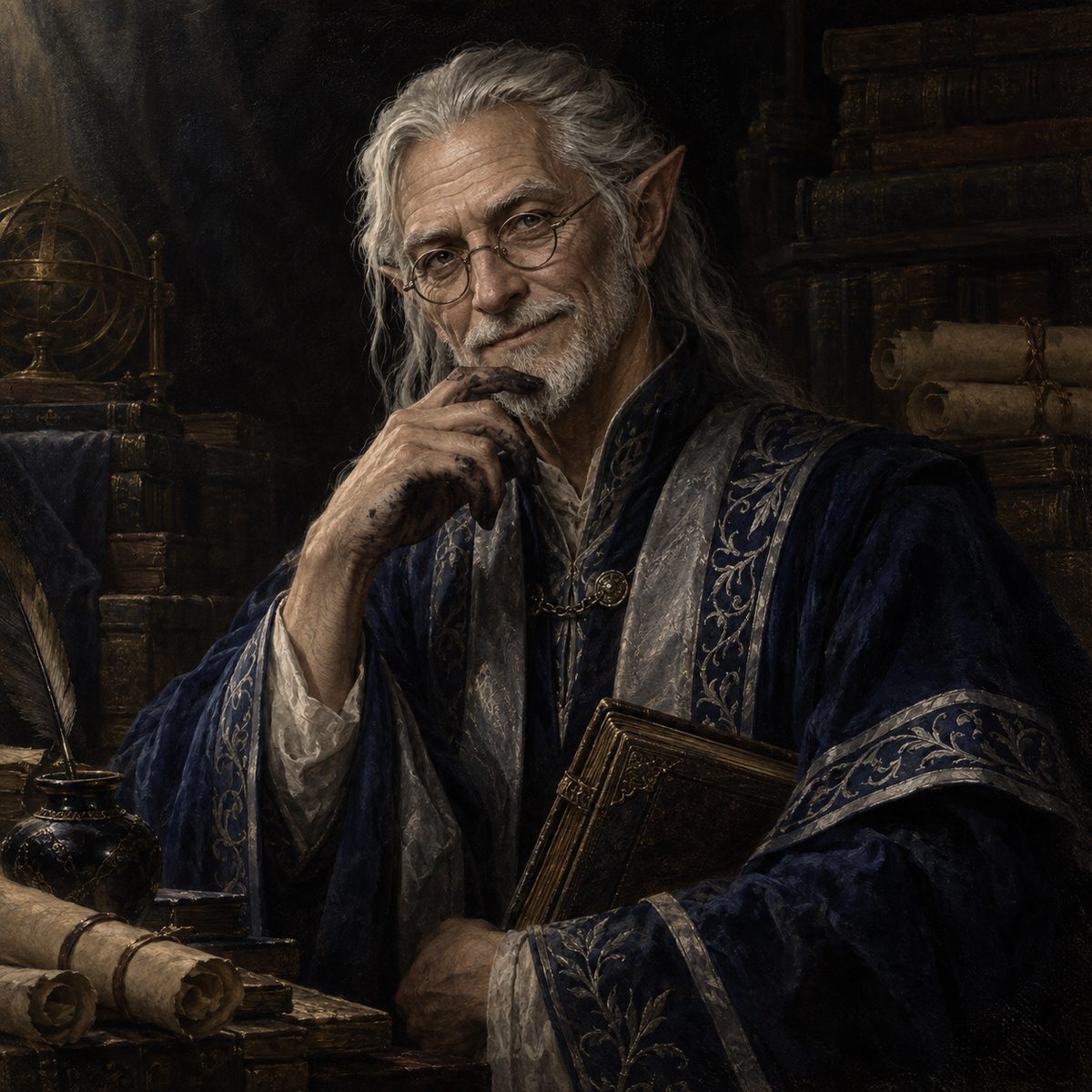
Orien Dast — "The Lorefather"
An elderly half-elf scholar who seems genuinely passionate about knowledge for its own sake — and who has imprisoned researchers for "learning too much." He does not consider this a contradiction. Some information, he says, is too dangerous to remain free. The fact that this reasoning also protects his monopoly is, in his view, a coincidence. Orien is the most paranoid person in Sanctum, and the most likely God to have information the party desperately needs — at a price they may not want to pay.
How They Operate
Every spellcaster in Sanctum pays licensing fees to the Archive. Unauthorized spellcasting is a contract violation. Their Archivists control all Delve cartography — selling map access by floor — and their maps are always slightly incomplete. The missing pieces cost extra. They control all printed media, meaning every story Sanctum tells about itself passes through Orien Dast's approval first.
The Thing They Sell That Would Hang Them Anywhere Else
Altair's Edict of the River makes divination a capital crime across the entire continent — nothing may be read ahead of the River Styx. The Archive performs it anyway, off the record, for a client list that does not exist on paper and is understood to include people in Gilder who would publicly demand its abolition. Nothing about this work is ever logged, receipted, or acknowledged.
Which is why the Archive is the most interested party in Altair regarding the prophet executed at Eryndor — cut down mid-sentence for speaking an unlawful prophecy about the rift in the sky. The crown discredited him and closed the matter. Orien Dast collects things the crown has closed. If a complete transcript of what that man was saying exists anywhere in the world, it is far more likely to be in a vault under the Endless Library than in any royal record.
The Archive's other standing problem is supply: the only source of surface spell components comparable to the Delve's is the frozen island of Ashheim, and every Ashheim shipment comes south through water held by five Pirate Captains. The Archive has been trying to solve that, expensively, for a century. It is the one negotiation Orien Dast has never won.
What They Want From You
Whatever you found down there. Whatever you know that you think is secret. Information is their currency, and they pay well — in knowledge you want, which creates debts you may not notice until it's too late.
The God
Castor Venn — "The Merchant-King"
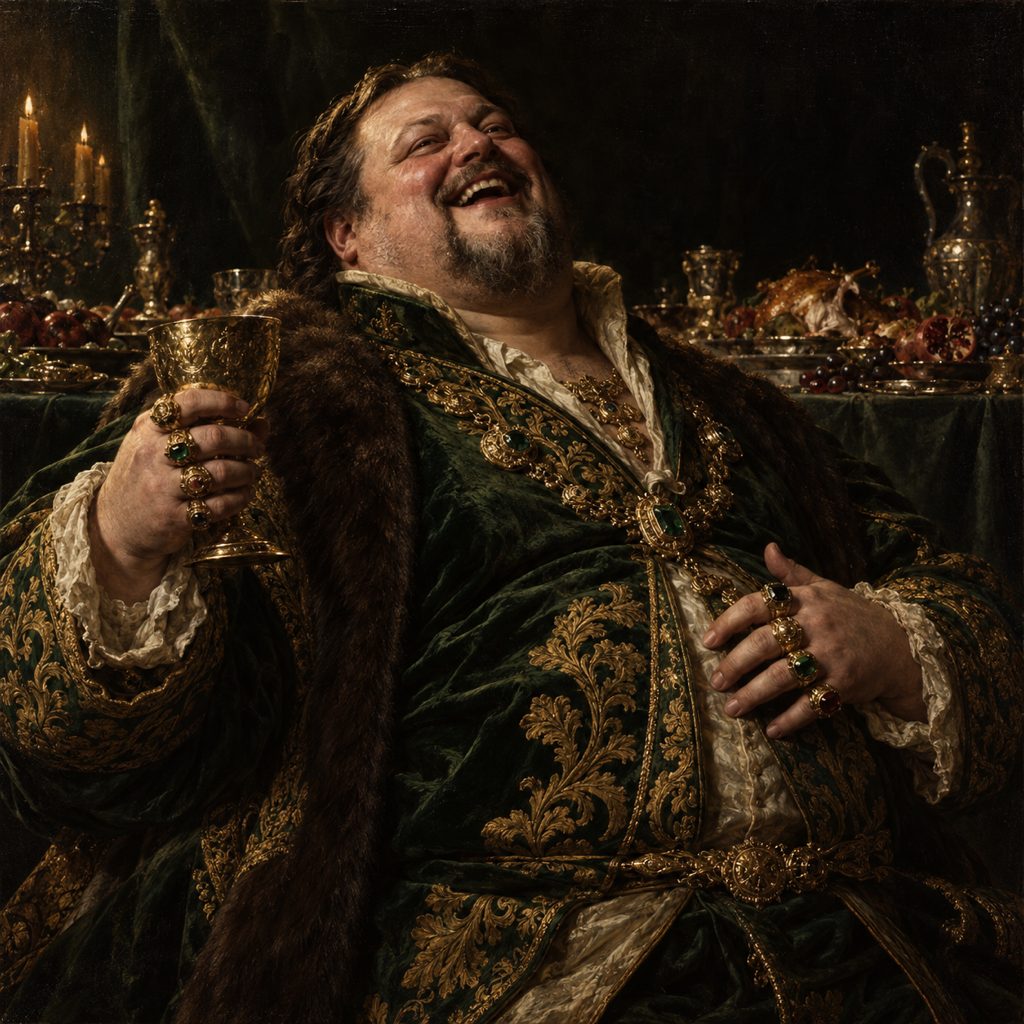
A large, laughing man who throws lavish public feasts twice a year in the Warren — redistributing food at below cost — while extracting it at above cost every other day. He calls this "balance" and genuinely enjoys the irony, making no effort to conceal it. Castor Venn is the only God who makes no pretense of virtue. He is openly, cheerfully exploitative — and somehow this honesty has earned him a grudging respect among people who have been lied to by everyone else. At least you know what you're dealing with.
How They Operate
The Abundance holds a legal monopoly on grain importation and price-sets everything else through market dominance. They have been suspected of engineering scarcity — holding shipments outside the walls until prices reach preferred levels. Nothing has ever been proven. Theft from an Abundance warehouse is treated, under Scales of Morreth law, as theft from a God.
Nothing Sanctum eats is grown in Sanctum. Grain comes up from the central farm towns — Hickory Hollow, Mirfield, Maplewood, Pinecrest, Leeside — and spice, perfume and southern luxuries arrive by Sandgrave caravan, all of it handled by bonded factors: licensed middlemen who carry the risk, hold the paperwork, and never live inside the walls. Independent merchants avoid this city, so the factors are the whole supply line, and Castor Venn owns the licences. A farmer four days' ride away sells at a fixed price to a man who has never touched a plough and whose name is on a Sanctum contract. This arrangement is the actual mechanism by which a God who controls no land controls the food of a hundred thousand people.
What They Want From You
Your labour, your tithes, and occasionally something from the Delve that he doesn't want on official record. Castor is straightforward about price. He is less straightforward about why he wants a particular thing.
The God
Rhael Dorn — "The Warlord-Penitent"
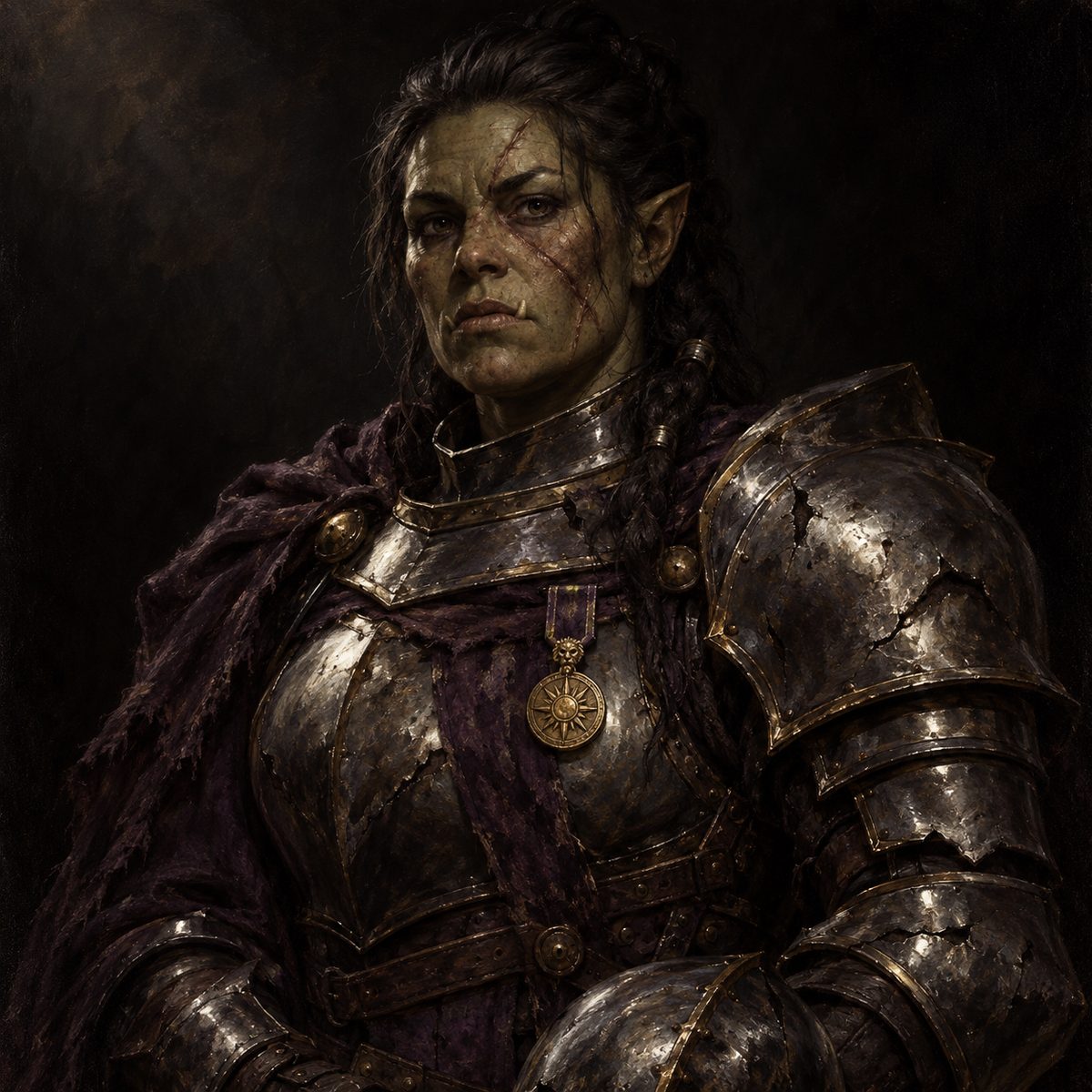
A scarred half-orc veteran who took control of the Congregation after what she calls a "crisis of conscience" and others call a massacre. She reformed the worst of its overt abuses and replaced them with subtler ones. Rhael is the most personally honourable God in Sanctum — she keeps her word, protects her debtors from outside threats, and genuinely grieves when her people die. She is also the most powerful enforcer of a system she knows is wrong, and she has decided that the alternative is worse. This unresolved tension makes her both the most sympathetic and the most useful God to understand.
How They Operate
Protection contracts are tiered — basic means guards will eventually respond, premium means a permanent patrol. Delve escort contracts are their most profitable service. They hold a complete monopoly on legal violence in Sanctum, meaning any faction that wants muscle either runs it through the Congregation or keeps it invisible.
What They Want From You
Either your service or your non-interference. Rhael Dorn has no interest in making enemies unnecessarily. She has more than enough already.

The God
Borrak Thune — "The Forgemaster"
A dwarf who rose from indentured labour to seize the Brotherhood through what he describes as "persuasion" and what others describe as "a very decisive explosion." He genuinely believes he represents the working class of Sanctum. He also believes that solidarity means everyone works for him. Borrak is the God most likely to be found on the shop floor — visible, loud, personally invested in what his people produce — and the one most likely to extend generous debt terms to struggling workers. Those terms mean the debt principal never quite reaches zero. He doesn't see the contradiction. That's somehow worse.
How They Operate
The Brotherhood holds a monopoly on smelting and advanced crafting of Delve materials, meaning every faction needs their services regardless of political alignment. This makes the Forgemaster quietly the second-most powerful God in the city, despite loudly claiming not to care about power.
Delve ore is the prestige product, but the Forge District runs on ordinary continental supply: stone, minerals and worked metal out of central Altair, western ore hauled through the pass at Luton, charcoal and timber down from the western logging country. Borrak Thune is the only God who has ever travelled outside the walls to negotiate personally, and he does it about once a year — which is also the only time a God can be legally touched by the Queen's law. He finds this very funny. His Wardens do not.
What They Want From You
Your skills and your loyalty to the labour — and ideally, your belief that working for him is the same thing as working for yourself. Some find that comforting. Others find it suffocating.
The God
Known only as "The Current"
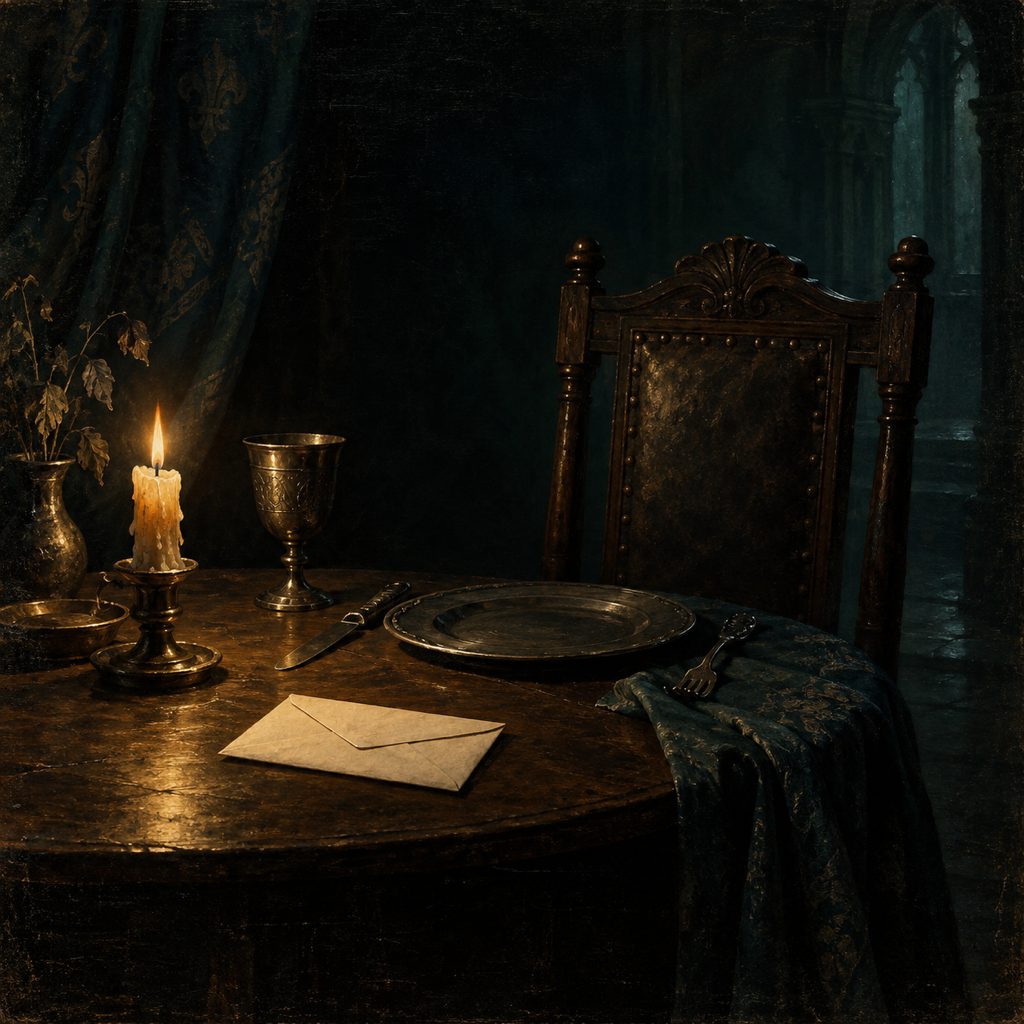
The working assumption among the other six Gods is that the Quiet Current is run by a collective with no single leader. The working assumption among the Quiet Current is that this misunderstanding is extremely useful. At least one of the other six recognised Gods is believed to be a member of the Current's inner circle. The identity of The Current — if a single person holds the title at all — is the most valuable secret in Sanctum, and the subject of more failed investigations than any other question in the city's history.
How They Operate
The Current's debtors don't always know they're in debt. A journalist who received a tip that saved their career. A delver whose crime was quietly expunged. A mother whose son's arrest record vanished. These people will receive a message someday, asking for something small — and then something less small. The Quiet Current deals in blackmail, extraction, counterintelligence, Gray Blessings, and occasionally murder — but also in genuine protection of those the other Gods have marked for destruction.
What They Want From You
A favour. To be named later. It always sounds reasonable when they ask. It is always more complicated than it sounds.